

Greetings from a sunny, wintery London. I was just in Tokyo and Okinawa, wrapping up my last bit of travel for the new book. Now to finish off the draft. I had a piece on Trump and India in Foreign Affairs too.
That and all all the usual pre-holiday reading and other things below. Enjoy the weekend!
Best wishes,
James

This is an occasional private mail for friends and family, with reading recommendations and other things that catch my eye. Feel free to unsubscribe below, if you’d rather not.
11 thoughts on the NSS

Last week’s NSS was a dramatic and, in many ways, quite weird document. A few thoughts:
[1] It’s obviously not great, especially for Europe and Ukraine. Natalie Tocci captures the “colonial menu” well.
“Trump wants the Ukraine war to end mainly because he sees it as an irritant preventing normalization of U.S.-Russia ties—especially the planned business deals between his entourage and the Kremlin’s cronies. The liberal world order is out; in its place comes survival of the fittest. Rather than old-fashioned superpower competition, Trump is keen to pursue imperial collusion with both Russia and China. The rest of the world, including Europe, is on the colonial menu.”
[2] These strategy documents are generally terrible guides to actual strategy. As my ECFR colleague Jeremy Shapiro points out in this excellent and very funny piece on “The Unbearable Lightness of Strategy”.
“The documents will be what they always are: a dense blend of slogans and generalities, leavened with a dog whistle or two. America will deter, compete, and prevail. Its leadership is indispensable, its values eternal… In real life, the Trump administration does not bother with even the pretense of strategy. Its foreign policy is improvisation tempered by corruption — a shifting mix of instinct, grievance, and spectacle. In private, everyone admits the obvious: Trump’s real national strategy is whatever happens to interest Trump at the moment.”
[3.] The drafting process was chaotic. And it shows. From what I understand, an original much longer draft from the White House was junked entirely. Drafting was then handed to Michael Anton, a conservative thinker in the State Dept policy planning department (see below). Anton has since left the administration, but the final, much shorter draft — just 16 pages — was mostly his work. That is where all the civilizational language and harsh European rhetoric comes from.
[4] You can see the editing joins. Various thing seem to have been grafted on later. The formulaic ChatGPT-style stuff on strategy — ends, ways, means, etc. —seems to have been added by others who felt it couldn’t just be a pure manifesto. The same is likely true for the big China economic sections, with an eye on not disrupting the planned summit with Xi. (See for instance para 8 of this piece by Demetri Sevastopulo in the FT last week on Stephen Miller becoming a de facto part-time national security advisor to ensure the Xi meeting happens.)
[5] The NSS is fundamentally economic in focus. “The future belongs to the makers,” as it says. Trump’s first NSS in 2017 centered on Russia and China with a big focus on “great power competition.” This version doesn’t even mention that, and Russia is pleased. Instead, it’s full of stuff about migration, re-industrialization, chips, critical minerals, energy dominance and so on.
[6] On China, it’s not all bad. See for instance this quite traditional paragraph, suggesting the U.S. will act to stop China dominating East Asia:
“The United States cannot allow any nation to become so dominant that it could threaten our interests. We will work with allies and partners to maintain global and regional balances of power to prevent the emergence of dominant adversaries.”
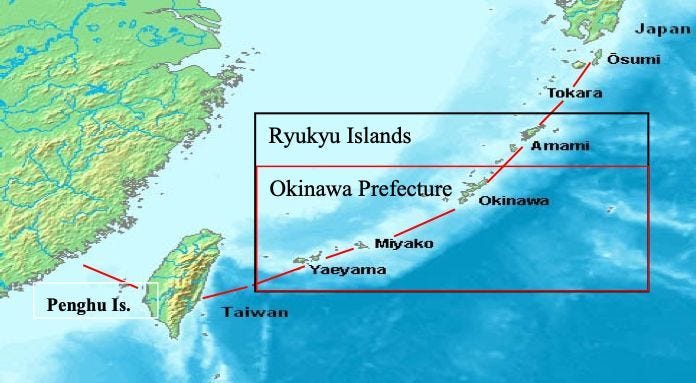
[7]. There is also a real focus on the island chains. Good news for those of us writing books on this topic. Here is one passage:
“We will build a military capable of denying aggression anywhere in the First Island Chain. But the American military cannot, and should not have to, do this alone. Our allies must step up and spend—and more importantly do—much more for collective defense... This will interlink maritime security issues along the First Island Chain while reinforcing U.S. and allies’ capacity to deny any attempt to seize Taiwan.”
The document also explicitly notes that Taiwan “provides direct access to the Second Island Chain and splits Northeast and Southeast Asia into two distinct theaters.”
[8] On Taiwan, the language provides some relief. Although softer in tone, it will probably provide a tiny bit of reassurance to worried policymakers in Taipei:
“Deterring a conflict over Taiwan, ideally by preserving military overmatch, is a priority.”
And in particular this, which had been a big focus in recent months:
“We will maintain our longstanding declaratory policy on Taiwan, meaning that the United States does not support any unilateral change to the status quo in the Taiwan Strait.”
9. The hemispheric focus is real. But it still isn’t entirely clear if this represents a genuine re-prioritization of resources, or whether it’s more of a MAGA head feint for the base that started out as being about trying to be tough on immigration and got a little out of control.
10. In general, watch what Trump does, not what the NSS says. As with this week’s baffling decision to give up on export controls. As Dmitri Alperovitch put it on the latest China Talks pod: “There’s no way to sugarcoat this—it’s a disaster.”
11. But this is Trump’s NSS, so take it seriously. Trump generally does not think strategically. The great power competition NSS in his first term was a reflection of his team, not him. This one reflects his instincts and is written by a team much more loyal to him. Many US allies and partners will read it and decide they can’t rely on America the way they used to. And they’d be right to think that — which is the point I made about India in my Foreign Affairs essay recently.
The NSS is here in PDF. It isn’t long and is worth reading. Also, feel free to read my Foreign Affairs essay here as a PDF.

** Book Update — Tokyo and Okinawa **
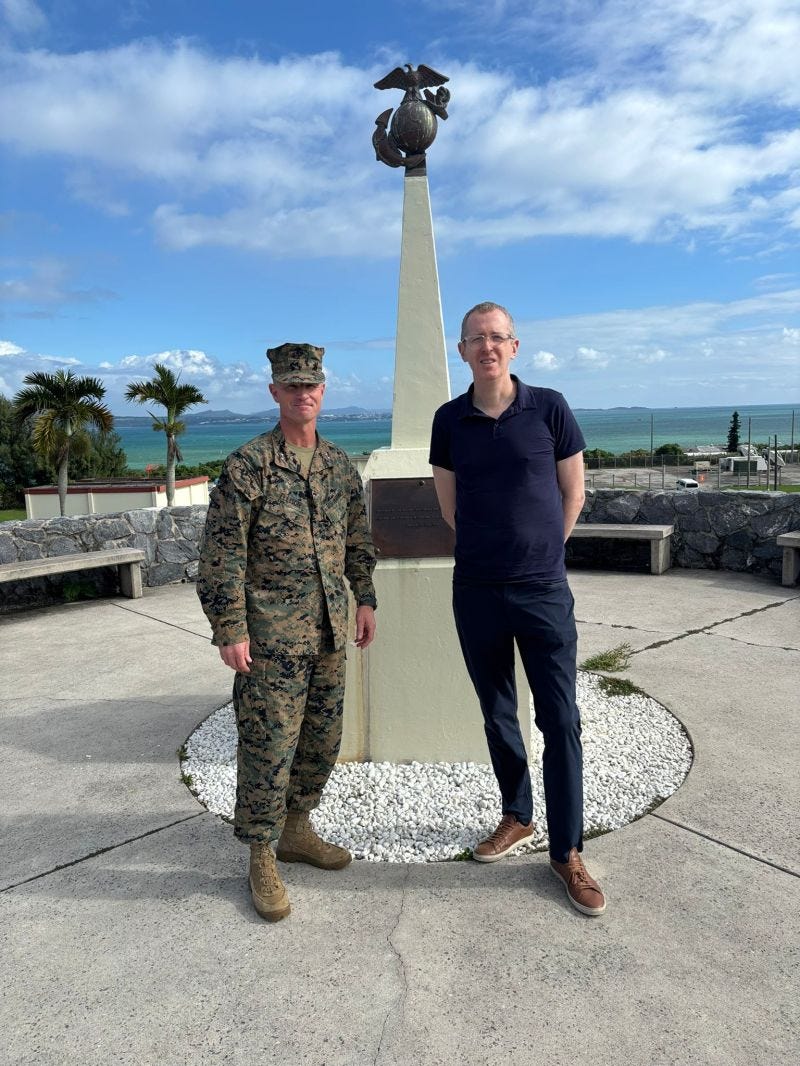
I’ve now pretty much wrapped up travel the for The Perimeter, which examines the position of the first island chain as the world’s most important geopolitical fault-line.
The latest (and final) trip to Tokyo and Okinawa was a highlight. Especially meeting Brigadier General Kyle Ellison, who leads III Marine Division.
I get to visit a lot of military bases…. This picture was at Camp Courtney on Okinawa, home of 3rd Marine Division, which controls roughly 20,000 Marines positioned mostly along the island chain. BgGen Ellison also leads the two Marine Littoral Regiments, the new units designed for island-hopping operations in contested maritime environments. I talk about them in the book.
…And some genuinely interesting people. In terms of China deterrence, Bg Gen Ellison is arguably one of the most important US military leaders in the Pacific theatre, with forces that would be at the sharp end of any Taiwan crisis scenario.
….And reflect on some sobering themes. The picture above shows the Iceberg Memorial at Camp Courtney. It commemorates more than 2000 Marines who fell during the Battle of Okinawa in 1945 — a battle in which nearly a quarter of a million people died overall, most of them Okinawan civilians.
Now: back to the library for the final leg of writing. The draft will be mostly done by Christmas. Wish me luck. The book itself comes out a full year later, in early 2027.
5 things worth reading

MAGA’s Machiavelli: The Quiet Rise of Michael Anton. Perceptive piece from Eli Lake in The Free Press on Anton, the ex State Department official who by all accounts wrote a lot of the NSS. He has been one of Trump’s most interesting intellectual outriders, now back in academia in Texas.
“With a mix of provocative broadsides in the media and unglamorous behind-the-scenes work in government, Anton has charted an improbable path, from the heart of the neoconservative establishment to the core of the new MAGA foreign policy establishment. Over a decade in which the American right has been defined by bad-tempered, friendship-ending fights, Anton, a Machiavelli scholar, hasn’t just survived the America First revolution, he has helped to shape it.”
Trump’s Power Paradox. Michael Kimmage in Foreign Affairs on Trump’s new hyper-transactional national security strategy. I liked this quote especially, with thanks to Richard Maude for pointing it out.
“Although the strategy document is unlikely to explain Trump’s day-to-day decision-making, it describes an aspirational world order. The order would not be American-led. It would not be the function of great-power competition or of civilizational clashes, and it would not be rules-based. It would issue instead from a dense network of personal relationships that supersede any alliances or any division of countries along the lines of democracy or authoritarianism.”
The Great Reckoning. Interesting long essay from Kaiser Kuo on what the west should learn from China. He argues persuasively that “modernity” is no longer exclusively Western, and also that the west is failing to understand the new kind of society is building China.
“We have witnessed not merely the rise of another great power, but a fundamental challenge to assumptions long embedded in Western thought—about development, political systems, and civilizational achievement itself. We simply haven’t yet found the intellectual courage to face it.”
How AI is re-writing childhood. More than half of American teens chat with AI companions regularly. 61% of high-school students use it for schoolwork. Students using AI score better but their brains show less activity. A generation is forming relationships with endlessly accommodating chatbots. And if that isn’t enough, check out the companion piece on AI and porn; one to read for any of us with sons.
“One-sided relationships with chatbots present a similar risk. AI companions that never criticise, nor share feelings of their own, are a poor preparation for dealing with imperfect humans. A third of American teenagers say they find chatting to an AI companion at least as satisfying as talking to a friend, and easier than talking to their parents. Yes-bots threaten to create children not used to taking turns, who grow up into colleagues unable to compromise and partners unfamiliar with the give-and-take required in a relationship.”
Who Influences Whom? Reflections on U.S. Government Outreach to Think Tanks. Finally, while we are praising Jeremy Shapiro, you should read this delightful and also very funny older piece of his, on the agonies of Think Tank Work, as the Chinese might call it.
I have sent this paragraph, in particular, to countless people.
The idea of this meeting is not to bring outside ideas into the government. To the senior government official, an outside idea—even a good one—is like a diamond ring on a desert island: abstractly valuable but practically useless. Regardless of his vaunted status, he feels in his daily existence penned in on every side by political and resource considerations that outsiders simply refuse to acknowledge. As he nods appreciatively and appears to hang on every word the thinkers spout, he is, in fact, hiding his tired familiarity with all of their arguments and his deep-seeded belief that every idea he hears is either politically impossible or already being attempted (or both).
What I’ve been up to
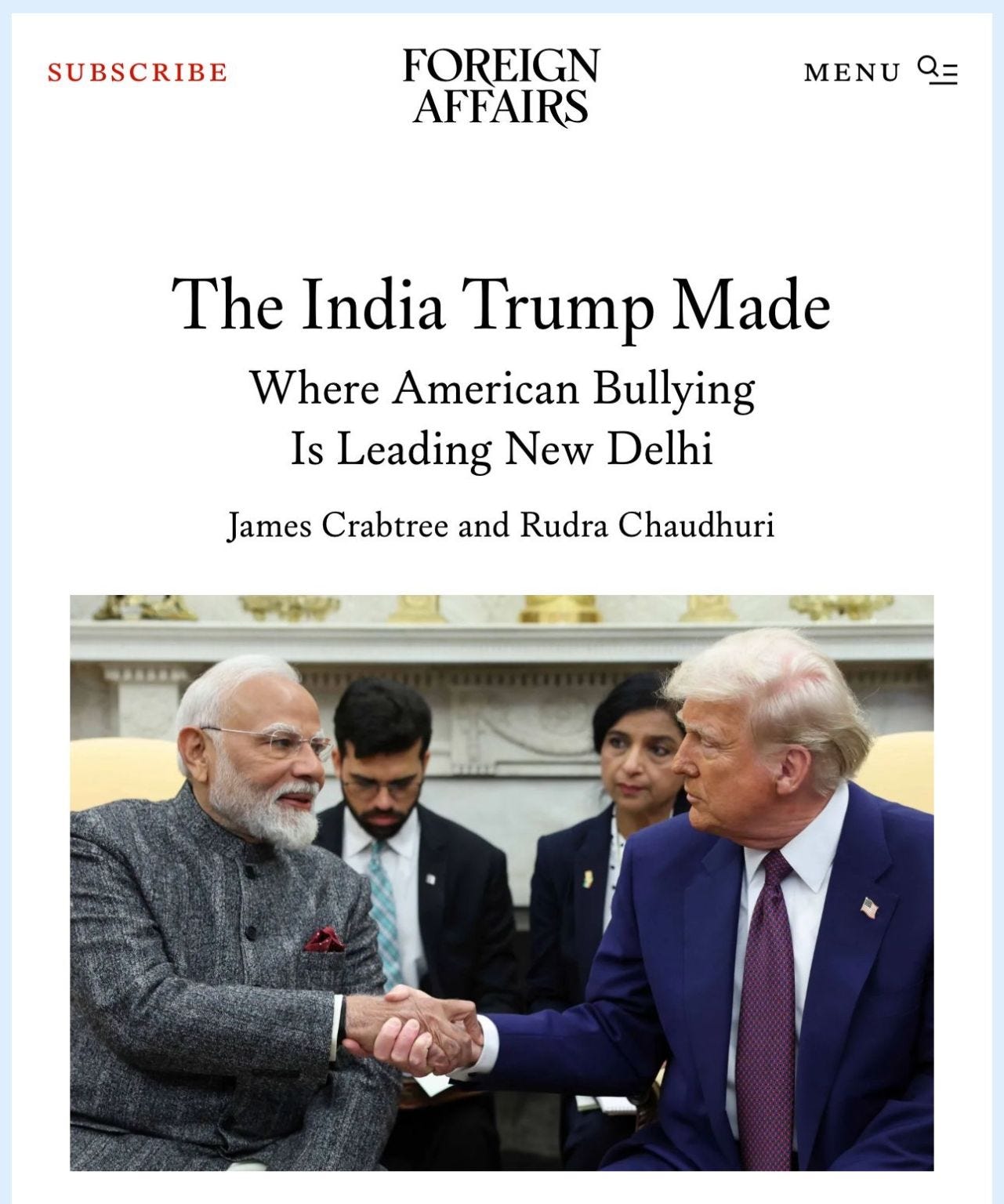
A piece in Foreign Affairs. On Trump, India, and the need for a pivot to Europe. Read it here.
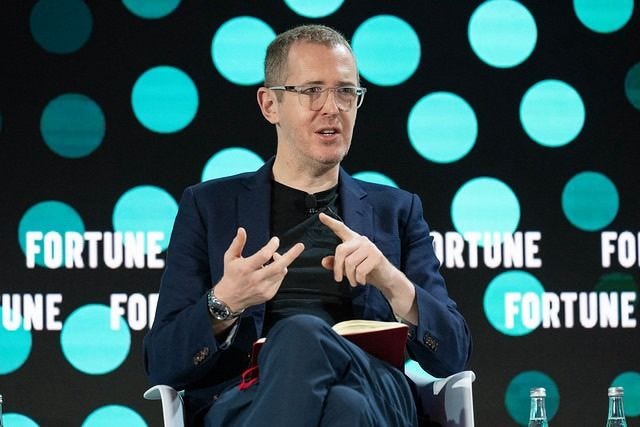
A brief stop in KL. Speaking at a pan at the Fortune Innovation Forum on big-picture geopolitics shaping Southeast Asia, where the region is feeling calmer about US-China tensions following recent summits. More here.
On CNBC-TV18, on India. Interesting long interview with Parikshit Luthra on the Foreign Affairs essay, on the forces reshaping India’s foreign policy. Watch here.


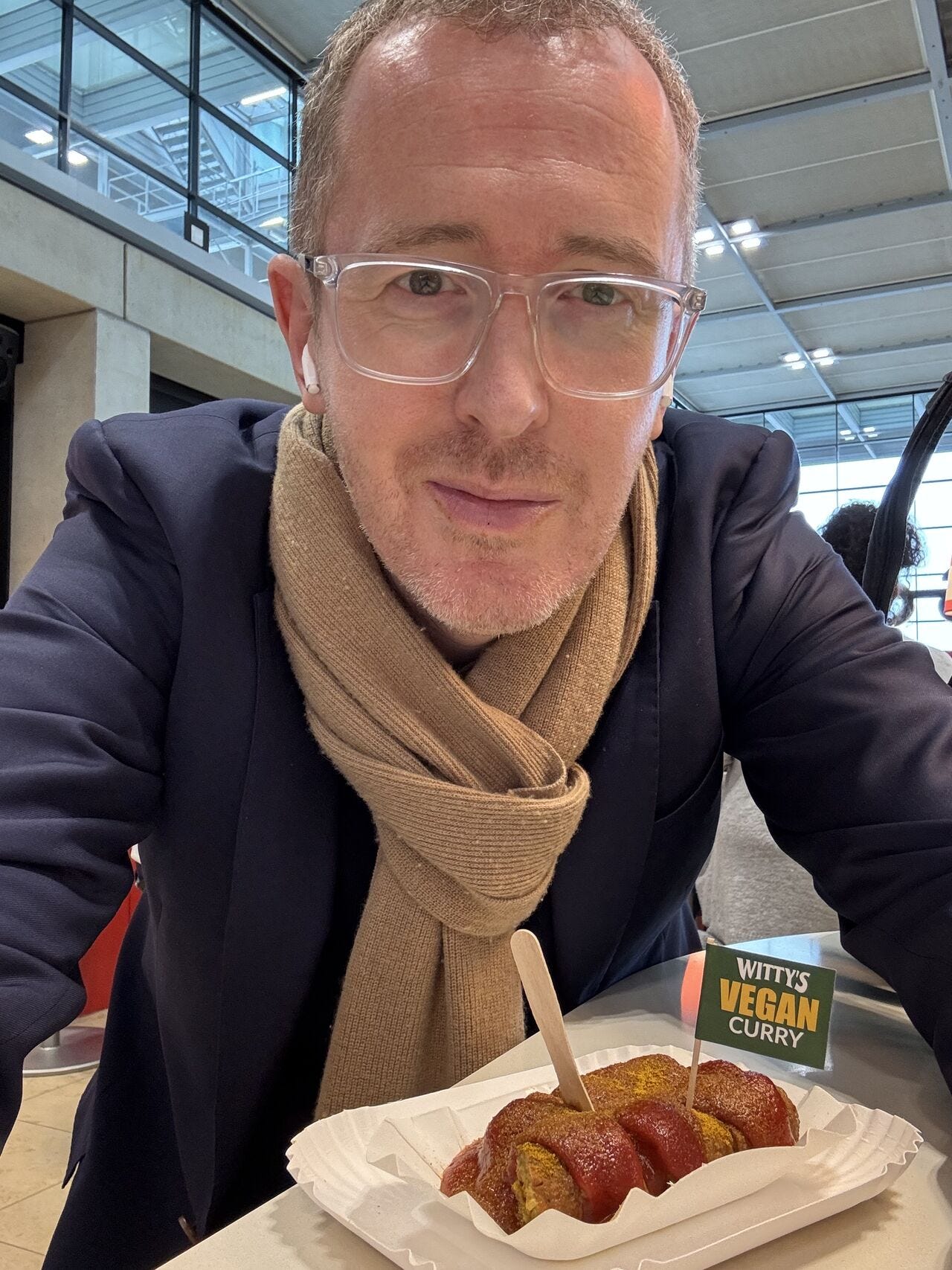
Eating vegan currywurst in Berlin. Always makes me happy. Also I helped to run a Europe / India workshop, and spoke at a Germany / Taiwan gathering.
Coming up: California for family Christmas; Delhi in late January for a conference and the Europe / India summit; San Francisco for Social Science FOO in Feb.
A friendly reminder: I do talks, and moderate things too. Drop me a line.
Thanks for reading. If this was forwarded to you, and you’d like to get it in future, feel free to click the blue button. You can also add me on LinkedIn.